Why Work-Life Balance Is Impossible for Leaders
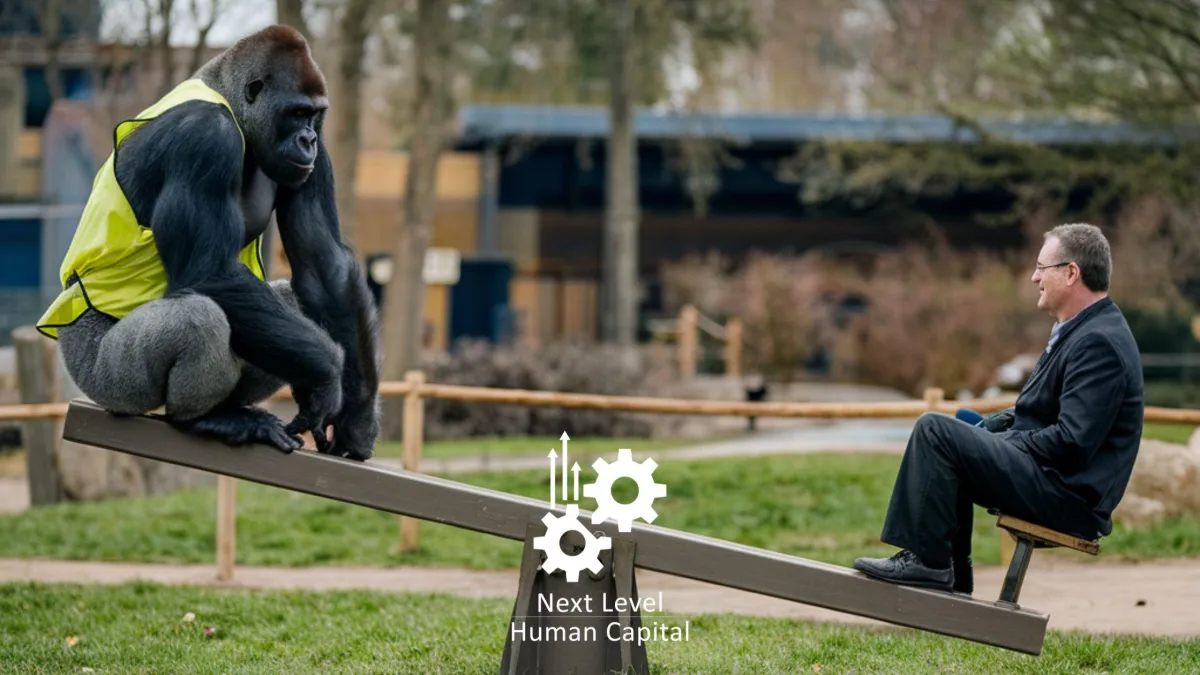
The Gorilla on the Teeter-Totter: Why Work-Life Balance Is Impossible for Leaders
By Tim Schumer | Founder, Next Level Human Capital
Leadership • Performance • Workplace Culture
Why “Work-Life Balance” Sets Leaders Up to Fail
Let’s get real.
Work-life balance is a fantasy.
A comforting idea—but completely disconnected from reality for entrepreneurs, executives, and leaders.
If you’ve ever tried to “balance” work and life and felt like you were failing at both, you’re not broken. The model is.
Balance assumes:
Equal weight
Predictable schedules
Clear separation
Leadership reality offers none of those.
And the sooner leaders stop chasing balance, the sooner they can build something that actually works.
The Gorilla on the Teeter-Totter (Why Balance Breaks Down)
Picture this.
You’re sitting on one end of a teeter-totter.
On the other end sits a 500-pound gorilla.
That gorilla is your work:
Your business
Your mission
Your responsibility to employees, customers, and stakeholders
No matter how hard you try, you will never “balance” that teeter-totter.
The gorilla is too heavy.
And pretending otherwise only leads to frustration.
That’s the fundamental flaw in work-life balance—it assumes equal weight.
For leaders, work is not just a job.
It’s identity, responsibility, and purpose.
Trying to balance it evenly against the rest of life is a losing battle from the start.
Why Work-Life Balance Fails Leaders
1. Balance Creates Chronic Guilt
Balance forces constant trade-offs.
At work → guilt about family
At home → guilt about work
Leaders end up:
Physically present, mentally absent
Emotionally stretched thin
Never fully “off” or “on”
This guilt cycle drains energy and clouds judgment.
2. Balance Ignores Mission-Driven Leadership
Entrepreneurs and executives are not clock-punchers.
They’re builders.
Balance treats work like an obligation.
Leaders experience it as a calling.
Ignoring that drive doesn’t reduce it—it turns it into internal conflict.
3. Balance Is Structurally Unrealistic
Life is not symmetrical.
Emergencies happen
Opportunities appear unexpectedly
People need you at inconvenient times
Trying to maintain balance in an unbalanced system is like trying to juggle chainsaws on a unicycle.
It’s not sustainable—and eventually, something drops.
The Alternative That Actually Works: Work-Life Integration
If balance is impossible, what works?
Integration.
Work-life integration doesn’t try to equalize weight.
It aligns priorities.
It recognizes that:
Work and life are interconnected
Leadership requires flexibility
Presence matters more than symmetry
Integration replaces the wrong question:
“How do I balance everything?”
With the right one:
“How do I align my mission, my energy, and my priorities?”
A Practical Framework for Work-Life Integration
This isn’t theory.
It’s how high-performing leaders actually operate.
Define Non-Negotiables (Mission-Critical Objectives)
In the military, mission-critical objectives happen no matter what.
For leaders, these may include:
Family dinners
Morning training or workouts
Weekly date nights
Faith, recovery, or personal development
These are not “nice to haves.”
They are operational requirements for sustained leadership performance.
Protect them accordingly.
Embrace the Chaos Instead of Fighting It
Entrepreneurship is messy by nature.
Integration doesn’t fight that reality—it plans for it.
That means:
Flexible schedules
Decision authority close to the leader
Permission to pivot when needed
Kids need you during the workday? Show up.
A business opportunity appears during family time? Address it.
Integration means being fully present wherever you are most needed.
Leverage Energy, Not Just Time
Time management is outdated.
Energy management wins.
High-performing leaders:
Do deep work during peak energy
Protect low-energy periods
Avoid major decisions when depleted
This isn’t self-care fluff.
It’s performance discipline.
Harvard Business Review consistently shows that leaders who manage energy outperform those who only manage time.
(Source: Harvard Business Review – Managing Energy, Not Time)
Communicate Priorities Clearly
In the military, unclear communication costs lives.
In business, it costs:
Trust
Alignment
Execution speed
Integration fails when expectations are vague.
Leaders must clearly communicate:
Availability
Decision boundaries
Performance expectations
Non-negotiables
Clarity removes friction.
Friction kills integration.
5. Measure Impact, Not Hours
Busyness is not leadership.
Yet many organizations still reward:
Long hours
Constant availability
Visible exhaustion
High-performing leaders shift the metric:
From hours → outcomes
From presence → results
From activity → impact
This shift alone:
Improves delegation
Reduces unnecessary meetings
Frees hours every week
Why Work-Life Integration Scales (Balance Doesn’t)
Here’s the overlooked advantage.
Integration scales. Balance doesn’t.
As businesses grow:
Responsibility increases
Complexity multiplies
Leadership demands expand
Balance breaks under that weight.
Integration adapts.
More Energy and Creativity
Less internal conflict = more mental bandwidth.
Better Leadership Decisions
Burnout impairs judgment.
Integrated leaders:
Think clearly
React less emotionally
Lead with intention under pressure
Stronger Workplace Culture
Leaders model integration.
Teams mirror behavior.
Integration improves:
Retention
Engagement
Trust
According to Gallup, burnout is one of the leading drivers of disengagement and turnover.
(Source: Gallup Workplace Burnout Studies)
Your Mission—If You Choose to Accept It
Integration starts with clarity.
Ask yourself:
What am I building?
Who am I responsible for?
What does success actually look like?
How does my personal life fuel—not compete with—this mission?
When purpose is clear:
Guilt fades
Trade-offs make sense
Work and life stop fighting each other
You stop apologizing—for working late and for being present at home—because both serve the mission.
Ready to Transform Leadership and Culture?
At Next Level Human Capital, we help entrepreneurs and leaders:
Replace burnout-driven systems
Build sustainable leadership models
Redesign HR and people strategy
Create cultures that retain top talent
If you’re ready to ditch the myth of work-life balance and build something that actually works, let’s talk.
📞 Phone: (314) 886-8516
📧 Email: [email protected]
📅 Schedule a Consultation:
👉 https://clb.nextlevel-hc.com/get-guide
Stop chasing balance.
Start building alignment.


