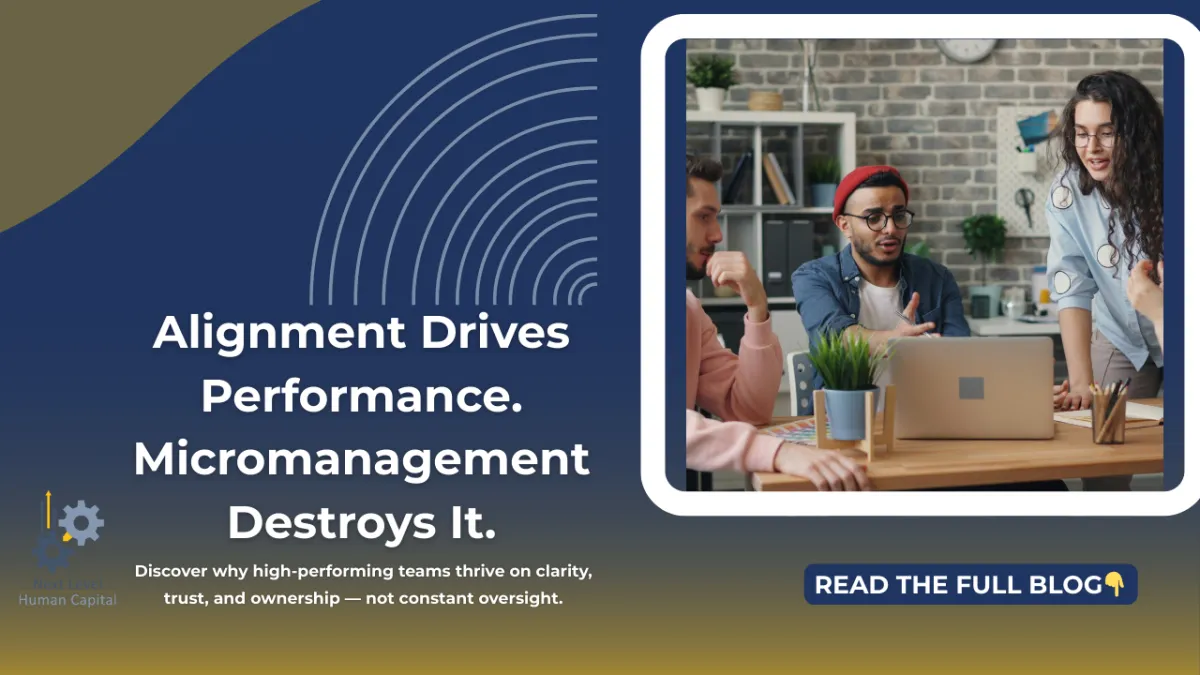
Aligning Goals Without Micromanagement: The Leadership Imperative for 2026
In 2026, alignment is no longer optional—it’s foundational.
But here’s the paradox leaders face every day:
Everyone wants aligned teams. No one wants to be micromanaged.
As organizations navigate hybrid work models, AI-assisted workflows, agile performance cycles, and rapidly shifting priorities, the old leadership playbook is breaking down. Leaders who rely on constant oversight, rigid controls, or task-level management are discovering something uncomfortable: micromanagement doesn’t create performance—it quietly destroys it.
High-performing organizations are proving a different truth:
Alignment comes from clarity, trust, and ownership—not control.
This article breaks down why micromanagement fails, what modern alignment actually requires, and how leaders can drive performance without hovering, using data-informed strategies built for 2026 and beyond.
Why Micromanagement Hurts Performance (Even When Intentions Are Good)
Most micromanagement doesn’t come from ego—it comes from fear.
Fear of missed deadlines
Fear of quality issues
Fear of losing control in a hybrid or remote environment
Fear that “if I don’t watch it, it won’t get done”
But decades of leadership research—and modern workplace data—tell a consistent story.
Micromanagement Leads To:
Lower employee engagement
Reduced confidence and autonomy
Slower execution and decision paralysis
Burnout and higher employee turnover
Declining creativity and innovation
According to Gallup’s engagement research, employees who feel trusted and empowered are 43% more productive and far more likely to stay with their organization. Conversely, excessive oversight pushes people into compliance mode.
When people feel watched, they stop thinking.
When people feel trusted, they start owning outcomes.
Micromanagement doesn’t improve accountability—it replaces ownership with dependency.
The Real Problem Isn’t Control — It’s Clarity
Here’s where many leaders get stuck:
They believe alignment requires more visibility, more approvals, more check-ins.
In reality, alignment breaks down before execution even begins.
Most teams struggle not because they lack effort—but because they lack:
Clear priorities
Defined outcomes
Decision authority
Context around why the work matters
When goals are unclear, leaders compensate with oversight.
When goals are clear, oversight becomes unnecessary.
The Modern Alignment Formula (Built for 2026)
High-performing organizations are adopting a simple but powerful shift:
Alignment = Clear Goals + Empowered People + Accountability Systems
This approach aligns directly with 2026 modern HR trends, including agile performance management, employee experience design, and leadership development frameworks.
Let’s break it down.
1. Set Outcome-Driven Goals (Not Task Lists)
Traditional goal setting focuses on activity.
Modern goal setting focuses on impact.
Instead of:
“Complete X tasks”
“Follow this process exactly”
Leaders define:
What success looks like
Why it matters
How progress will be measured
This shift supports:
Goal setting aligned with business performance
Employee engagement through purpose
Agile performance management cycles
🔑 Clarity replaces control.
2. Communicate the “Why,” Not Just the “What”
Employees don’t disengage because they don’t care.
They disengage when work feels disconnected from meaning.
Modern leadership requires context-rich communication, especially in hybrid environments.
When people understand:
How their work supports business growth
How it connects to customers or outcomes
How success will be evaluated
They make better decisions without supervision.
This is a cornerstone of reflective goal-setting and leadership development in 2026.
3. Replace Oversight With Ownership
Ownership doesn’t mean absence—it means responsibility.
Leaders build ownership by:
Allowing employees to determine how goals are executed
Granting decision-making authority within defined guardrails
Holding people accountable for outcomes—not activity
This supports:
Team productivity
Employee autonomy
Performance accountability
Retention in competitive talent markets
Ownership scales. Micromanagement does not.
4. Coach Progress Instead of Policing Performance
Modern leaders act as performance coaches, not inspectors.
That means:
Reviewing milestones, not every task
Asking reflective questions instead of issuing directives
Offering feedback that develops capability—not fear
This aligns with:
Agile performance management
Leadership development best practices
Psychological safety and trust-based cultures
Feedback should guide growth—not control behavior.
5. Build Trust as a Leadership System, Not a Personality Trait
Trust isn’t soft—it’s operational.
Organizations that outperform their peers intentionally design:
Clear expectations
Transparent accountability systems
Consistent leadership behaviors
Trust thrives when:
Goals are visible
Metrics are fair
Accountability is shared
This is why HR strategy in 2026 focuses on systems, not slogans.
Alignment Without Micromanagement in Hybrid & AI-Enabled Workplaces
As AI-assisted HR tools, performance analytics, and hybrid models expand, leaders face a new risk: digital micromanagement.
Excessive tracking, constant dashboards, and real-time monitoring can quietly recreate the same trust issues—just with better technology.
Smart organizations use AI to:
Support clarity
Identify trends
Enable coaching conversations
Not to surveil people.
Technology should amplify leadership—not replace it.
The Business Impact of Getting This Right
Organizations that align goals without micromanaging see measurable results:
Higher employee engagement scores
Stronger retention and reduced burnout
Faster execution and decision-making
Increased innovation and accountability
Healthier leadership pipelines
In short:
Alignment fuels performance. Trust sustains it.
How Next Level Human Capital Helps Leaders Scale Without Control
At Next Level Human Capital, we help executives, founders, and HR leaders redesign performance systems that align goals, empower people, and eliminate the need for micromanagement.
Our work includes:
Leadership development programs
Executive coaching
Agile performance management design
HR systems aligned to modern work realities
We help leaders move from control-based management to clarity-driven performance.
📞 Phone: (314) 886-8516
📧 Email: [email protected]
📅 Schedule a Consultation:
👉 https://clb.nextlevel-hc.com/get-guide
The best leaders don’t manage every move.
They set direction, build trust, and let people deliver.
In 2026 and beyond, the organizations that win won’t be the most controlled.
They’ll be the most aligned.
Balance is a myth. Alignment is the advantage.


